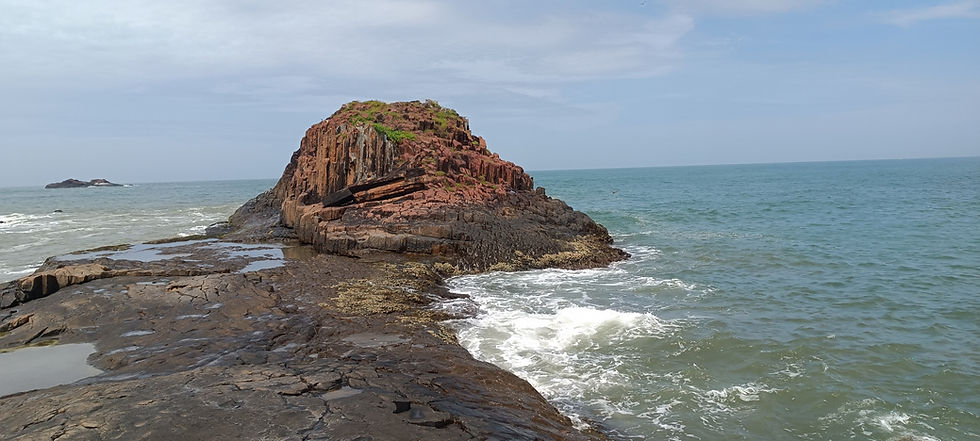
La Mer / The Sea

.Dear Reader,
In this fortieth edition of Geosophy, I wanted to stray from the usual format, and explore how writing that centres geographical features, can serve as a footnote to art, a gateway to culture, and perhaps, a unique lens with which to view the world.
For years, literature, art and culture have found rich inspiration in the natural world. As our understanding of the natural world is enriched, can science use the tools of language, music, and performance to convey the fragile beauty of the world around us, and the urgent need to protect it? Can nature writing bridge the gap between science and society?
The ‘Lost Woods: The Discovered Writing of Rachel Carson’, is a beautiful testament to how nature writing can be found in the most unexpected of places. In this collection of stories, Rachel Carson, best known for her ground-breaking ‘Silent Spring’ and 'The Sea Trilogy', delves into other topics from science communication and biodiversity, to wildlife parks and politics.
At some point, Rachel was approached to write jacket notes for a recording of Claude Debussy’s orchestral composition, La Mer (The Sea). With no musical training, Carson followed the same evocative expression used in her nature writings to explain Debussy’s inspiration for the composition, drawing richly from her knowledge of the seas and the processes that shaped them.
Here are short reflections on some haunting, evocative paragraphs of her writing. It invites you to ponder how nature writing can spill over into other aspects of our lives and weave itself into the other art forms we consume.
What follows are excerpts from Rachel Carson’s essay (in italics), with my reflections on how the words conjure up the landscapes and offer lyrical descriptions of the processes that shaped our seas.
📝 Read: Jacket Notes on La Mer by Rachel Carson (as published in Lost Woods)
🎼 Listen: Claude Debussy: La Mer (by Bernard Haitink and the Royal Concertgebouw Orchestra)

~~~~~~~~~~~~~~~~~~~~~~~~~~~~~~~~~~~~~~~~
Out of his “endless store of memories,” Debussy has created a world of water and sky, crossed by the hurrying forms of waves and holding endless converse with the great winds that ceaselessly blow over the surface of the earth. It is a timeless, elemental world, in which the passage of the years and the centuries and the eons are lost in time itself – a world that might be of the Archeozoic Era or of the Twentieth Century.
In this paragraph, Carson steps into Debussy’s shoes, imagining how the fluid canvas of earth, sky and waves inspired him. Her usage of hurrying, endless, and ceaselessly, conveys a sense of timelessness, reinforced by her following phrase. No metaphor expresses eternity better than the ebb and flow of the sea and it is easy to imagine such a landscape, both ever-changing yet immortal, witnessing the tides of Time, and the ages of the Earth. In a sense, music also has this timeless quality, and it is difficult to say which era it was born in, and how the ages of Man continue to reimagine the melodies.
~~~~~~~~~~~~~~~~~~~~~~~~~~~~~~~~~~~~~~~~
The sea is never at rest. The thin interface between air and water is exquisitely sensitive to the slightest disturbance. A drop of rain, a seabird coming down to alight on the water, a fish cutting the surface with its fin, set spreading ripples in motion. And always the winds, blowing over the face of the globe, are pushing up the water into the moving ridges of waves. The open sea is a playground of waves created by many different winds, rolling on diverse paths, intermingling, overtaking, passing, or sometimes engulfing one another. Born of wind and water, each young wave takes its place in the confused pattern of the open sea. Drawing energy from the winds that created them, the waves respond to the fury of the storm, trailing white streamers of foam, leaping up into steep, peaked shapes, crowding upon their fellows in a wild, abandoned play. In the wide immensity of the open sea, a wave knows no restraint; were it not for the intercepting masses of the continents it might roll on and on around the earth. But nearing shore, it feels the alien land beneath it. Against the drag of shoaling bottom its speed slackens. Within the surf zone it suddenly rears high, as though gathering strength against an unknown adversary. A white, foaming crest begins to form along its advancing front, and suddenly this shining creation of the open sea plunges forward and dissolves in thunder.
The impatience of the sea, and the different forces acting upon it - the wind, the rain, the land, have been captured beautifully in this passage. It is almost alive, full of verbs that give it a sense of immediacy. For anyone who has experienced the sea and been riveted by the birth of a wave, we can imagine these very movements occurring time and time again. The shining creation of a white, foaming crest, plunging forward and dissolving into thunder — such a sight is what draws most of us to the coast to stare for hours across the distant horizon.
~~~~~~~~~~~~~~~~~~~~~~~~~~~~~~~~~~~~~~~~

The waves are the most eloquent of the sea’s voices. In their wordless language they speak of the shrieking gales of the southern ocean, of the great anticyclonic winds sweeping around the Icelandic low, or they run directly ahead of an approaching storm, crying a warning. As they roll majestically in open ocean or as they break and surge at the edge of land, their voices are the voice of the sea.
To stretch imagination a little further than the horizon, Carson takes us on a journey buoyed upon distant waves. Where do these waves come from? What tempests and terrors have they seen? What stories do they tell?
~~~~~~~~~~~~~~~~~~~~~~~~~~~~~~~~~~~~~~~~
What is this sea, and wherein lies its power so greatly to stir the minds of men? What is the mystery of it, intangible, yet inseparably its own? Perhaps part of the mystery resides in its hoary antiquity, for the sea is almost as old as earthly time. Its shadowy beginnings lie somewhere in that dim period when the earth was forming out of chaos, when deep basins were hollowed out of the cooling rocks and the rains began to fall from the thick cloud blanket that enveloped the earth. The rains poured upon the waiting basins, or falling upon the continents, drained away to become sea. And there began at once that slow erosion by which the continents are giving up their substance to the sea, by which the minerals are passing from earth to sea, and the sea is becoming ever more briny with the passing eons.
Despite being a cover for a musical composition, Carson has woven the threads of science into her jacket notes. In this excerpt, she talks of the history of the planet and the formation of its deep-basined oceans. In her evocative style, she paints a vivid picture of how ancient seas were formed on continental blocks, and how they turned salty - and the inexorable processes that continue to this day. This timelessness is part of the grand mystery and allure of the sea, and why, through the ages, we have both feared and revered it.
~~~~~~~~~~~~~~~~~~~~~~~~~~~~~~~~~~~~~~~~

For hundreds of millions of years, all life was sea life, developing in prodigious abundance and variety, evolving into thousands of kinds of creatures, some of which finally crept out of the sea, some of which, after long eons of time, became men. But we as man carry the sea’s salt in our blood, and the trace of our marine heritage in our bodies, and perhaps something akin to a racial memory of that dim past lies within us.
If only our geography textbooks described the processes that shaped the planet and its biodiversity as beautifully! The sea bears witness to the rise and fall of mountains and islands, and gave rise to the multitude of lifeforms. Perhaps, each of us, bears distant memories of the sea in our blood and is drawn to it, as inexorably as the rivers and rain.
Perhaps it is not a coincidence that the words for mother and the sea (la mere and la mer) bear such a close resemblance in Debussy’s native language, French.
~~~~~~~~~~~~~~~~~~~~~~~~~~~~~~~~~~~~~~~~
If you enjoyed these short reflections, I would urge you to read Rachel Carson’s essay:
📝 Read: Jacket Notes on La Mer by Rachel Carson (as published in Lost Woods)