
Water Seekers & River Keepers
Dear Reader,
I’ve been mulling over this topic for the past few weeks, and it seems apt that I start writing this just as summer’s first drizzle ends (or rather moves southwards, as it often does in Bangalore at this time of year). I hope to dispatch it on March 22nd, to mark ‘World Water Day’.
Perhaps, with the recent war, fuel shortages, and aviation disruptions, you may have missed the news of a super El Niño forecast — experts say it heralds unusually warmer waters in the Pacific Ocean, higher global temperatures, with disrupted patterns of precipitation that will cause floods in some regions, and droughts in others.
In the urban world, we often take water for granted till sources run dry. Throughout the year, we use water carelessly and thoughtlessly till the summer shortages hit, and even then, we haggle, bully and buy our way out of the crisis. Water scarcity, like all other global crises, disproportionately affects poorer communities — and it is often within these very communities that traditional wisdom of water management can still be tapped. As urbanites, we’ve almost forgotten the water management techniques on which our cities were built, yet we may still turn to them in times of need.
School history taught us how early civilizations were established along river valleys; and some collapsed when their water reserves failed. Beyond rivers or perennial water sources, settlements have had to rely on good water management practices — the underground tunnels or qanats of ancient Persia, the Incan terraced fields, the canals or acequias in medieval Spain, the Mediterranean waterwheels or noria, the tanks (kunds) and stepwells (baoris/vavs) of India, to name a few.
This edition hopes to trace water as a resource over time, to better understand the foundation of our water sovereignty today. Yet this is a shaky, uncertain foundation built on the hubris of the Industrial Age, where we sought to overcome nature’s shackles and achieve mastery over the elements. When the illusion of control fades, we realise just how reliant we are on natural resources, especially water.
Water Histories
When studying ancient cultures, both nomadic and sedentary, archaeologists seek to identify the water sources that enabled them to thrive. Nomadic hunter-gatherers migrated in search of water, whereas semi-permanent to permanent civilizations could only be established with reliable, near-perennial or perennial sources of water. In this essay, co-authored with Prateek Dasgupta, we explored how water cisterns support the case that Göbekli Tepe was a semi-sedentary civilization:
As semi-sedentary settlements evolved into permanent settlements and, in turn, into cities, identifying, tapping into and sustaining water sources became critical. Innovations in irrigation led to agricultural expansion; water channels improved sanitation and hygiene in densely populated centres; and a settlement’s water sovereignty determined its resilience in the face of military sieges and climatic irregularities.
In 2010, I visited Dholavira — an Indus Valley site in the salty heart of the Rann of Kutch, Gujarat — and found myself looking into a stone well, connected with a few channels to other parts of the ruins. At the time, I was working on my Master’s dissertation in geohydrology, and it was a delight to unravel ancient water management clues, and hazard at what may have caused the decline of the civilization.

If you’ve visited an archaeological site, perhaps the guide has drawn your attention to a water management system? The Roman aqueducts, sewers and public baths; Egyptian temples with sacred ponds; the sacred cenote at Chichen Itza in Mexico; the Basilica cistern in Istanbul; and the water gardens of Sigiriya in Sri Lanka, are some well-known examples outside India.
The archaeological remnants often hide humbler human histories — of the water seekers, water diviners, water tappers, well-diggers, water-bearers, water-harvesters, and engineers who invented water-screws, watermills and waterwheels, among other water-harvesting systems.
In India alone, traditional water-based professions included mannu vaddar, bhovi, boyan, odde, vodden (well-diggers), the Bishti, Mashki or paniwallahs (water-bearers), the gandhar (water surveyors), the neerkatti, kollalu, churpun, patkari, jagaliya, havaldars (water managers), and the kulthos kultas, binjhal, kondh (tank builders).
Water-related professions existed in every part of the world. One can only imagine the lexicon we could compile of such professions and the diversity of water management systems!
Water in the Industrial Age
As civilizations moved from agrarian economies to industrial ones, with the power of water harnessed not just as kinetic or potential energy, but as steam, communities and commercial ventures competed for a limited resource. Rivers, lakes, and canals became vital for transporting raw materials and finished products, acting as commercial lifelines.
As industries for textiles, paper and pulp, tanneries, and chemical manufacturing emerged, they consumed massive amounts of water for washing, cleaning and processing raw materials. The large-scale machinery for oil refining and metallurgy used huge quantities of water for cooling, and waterbodies were used to dump wastewater, toxic metals, dyes, chemicals, and acids.
Early industrial development led to severe environmental degradation until strict regulations were put into place. Urban centres tried to clean up their industrial footprint by installing sewage and sanitation infrastructure, and polluting infrastructure was moved to the city’s edges, where it continued to pollute water resources in remote countrysides.
As colonies were established in far-flung corners of the world, the industrial burden was passed on; large-scale canals and channels were constructed to cultivate cash crops, and dams were erected to harness electricity. The colonial era undermined centuries of traditional knowledge, and most of the water-based professions disappeared as technology took over. Water became a commodity rather than a shared resource.
Water: The Origin of Life on Earth
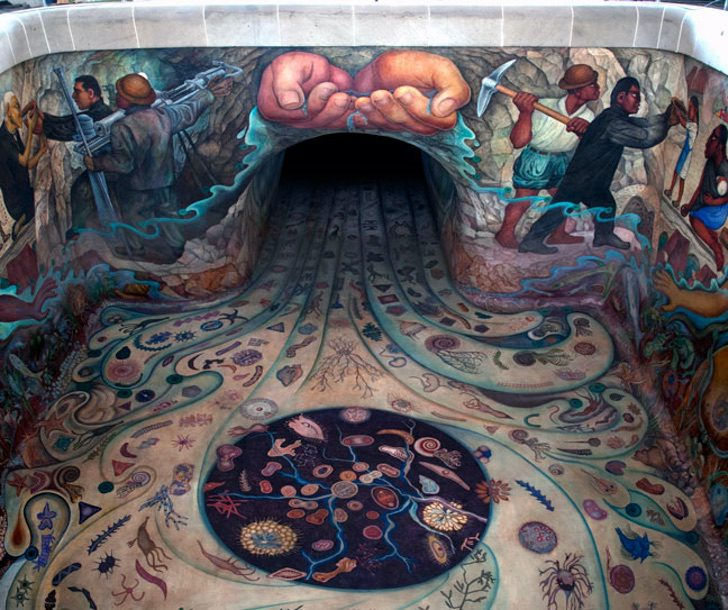
In the post-colonial era, newly forged, developing nations reimagined the role of hydraulic projects, and harnessed them for political, environmental and social change.
In 1950, Diego Rivera began work on his last grand public mural within the tunnels of Cisterna Lerma under the Chapultepec park of Mexico City. The mural, along with sculptures, features ancient gods, Indigenous peoples, miners, engineers — and artistic endeavour to capture the hydraulic history and future of a civilization. As the artist celebrated industry and human ingenuity over the natural world, a new page of history was being turned: water became a resource that polities could control.
In 1956, the Suez Canal was nationalised in a bid to reclaim desert land, generate electricity, and establish political independence from imperial powers. In India, dams were proposed for hydroelectricity, and as a more reliable, perennial source of water. Other nations across Asia and Africa followed suit. Throughout the Cold War, Western powers and the Soviet Union competed to finance major infrastructure projects to secure political alliances in the developing world.
In the 1980s, the initial euphoria surrounding large dams diminished when their social and environmental costs became apparent. Yet in India, dam-building continued, despite pressure from advocacy networks to reevaluate the efficiency of these projects. China’s dam-building juggernaut hasn’t slowed down even in this decade.
From an economic standpoint, Nature forced, shackled, and yoked was seen as the symbol of development and progress. Yet geography begs us to pause and reconsider.
Determinism & Possibilism: Humans versus the Environment
In geography, we study worldviews or philosophies that seek to explain the relationship between humans and the environment. Determinism posits that the physical environment (topography, climate, and resource availability) determines human development and shapes our culture and actions. Possibilism believes that humans can adapt, actively shape their environment through technology and ingenuity, and even master the elements, thereby shaping our culture and destiny.
Human history offers several examples that support both theories, yet there are limits to both natural resources and human ingenuity. Later, an Australian geographer, Griffith Taylor, proposed the term ‘neo-determinism’, which argues that humans can influence development but must work within natural limits, much like a traffic controller who can speed up, slow down, or stop traffic (development) but cannot change its trajectory.
Over decades, we’ve seen our hubris crumble. In 1959, France’s Malpasset dam collapsed because we failed to understand how water can build up pressure enough to undermine the geology. In 1975, China’s Banqiao and Shimantan dams were destroyed by a typhoon. In 2013 and 2025, Uttarakhand’s flash floods, exacerbated by damming projects further upstream, took a heavy toll on human life and infrastructure.

Beyond dam projects, other ambitions have also met watery ends. After centuries of drainage for land reclamation (such reclaimed tracts are known as polders), the Netherlands’ over-exploitation of water has caused peat soil decomposition, land subsidence, and saltwater intrusion. In Central Asia, the Aral Sea, once the world's fourth-largest freshwater lake, has largely disappeared due to massive water diversion for irrigation. What remains is a salty, polluted landscape — a stark example of ecological collapse caused by human exploitation. In recent years, Mexico City, Jakarta, and Tehran have excessively pumped groundwater to meet the needs of their urban populations, permanently reducing the storage potential of local aquifers.
Water Futures
All is not lost yet. In the face of climatic irregularities and extreme weather events, we can build water-resilient futures by working with Nature, not trying to fight her.
The United Nations Development Programme classifies these as nature-based solutions. Solutions that use or mimic natural processes include soil moisture retention and groundwater recharge to enhance water availability, natural and constructed wetlands or riparian buffer strips to improve water quality, and floodplain restoration and green roofs to mitigate water‐related disasters and climate change.
World over, we’re seeing examples of nature-based solutions, often championed by communities and drawing on traditional wisdom. Mangrove restoration projects aim to prevent saltwater intrusion into freshwater sources and protect coastlines and communities from storm surges. Some communities have been protecting agricultural areas and forests to ensure that rain percolates into the ground and replenishes the city's drinking water reserves. Others are preserving natural wetlands or constructing wetlands to regulate water recharge and quality. River restoration or rejuvenation projects focus on source-to-sea functioning to support biodiversity conservation, flood control, drought-proofing, and groundwater recharge, among other key ecosystem services.
Yet, as with all solutions, there is a risk of corporate capture where private profits override public interest, false narratives that promise more than they can deliver, and greenwashing. If we’re learning anything, it is that one-size cannot fit all, and hyperlocal contexts are key to good water management.
The Riverkeepers
In 2024, Grist announced its fifth Imagine 2200, a climate fiction contest to envision the next ~180 years of climate progress. I spent weeks thinking about what that world would be like, and how communities would find a way to thrive. If you’ve followed Geosophy for a while, or dived into the articles enough, you may have noticed my fervent passion for rivers. As rivers had given birth to civilizations, I felt rivers could play a key role in restoring devastated landscapes. The germ of an idea took hold.

After hours of research, several rounds of edits, massive restructuring, and all the usual toils and travails of storytelling, I had my first-ever serious fiction story titled ‘The Riverkeepers’. Then followed months of waiting, punctuated by heartening emails that said the story was still under consideration. Till that final rejection email! It was a rare, heartfelt note that took the bite out of the rejection. What’s more, it announced that of 1600+ entries, my story had made it to the 18th place. I couldn’t be prouder.
Here’s a downloadable copy of ‘The Riverkeepers’, with a stunning cover by Priyanka Bajaj.
If you enjoyed this newsletter, The Riverkeepers, or want to support Geosophy, buy me a coffee?


